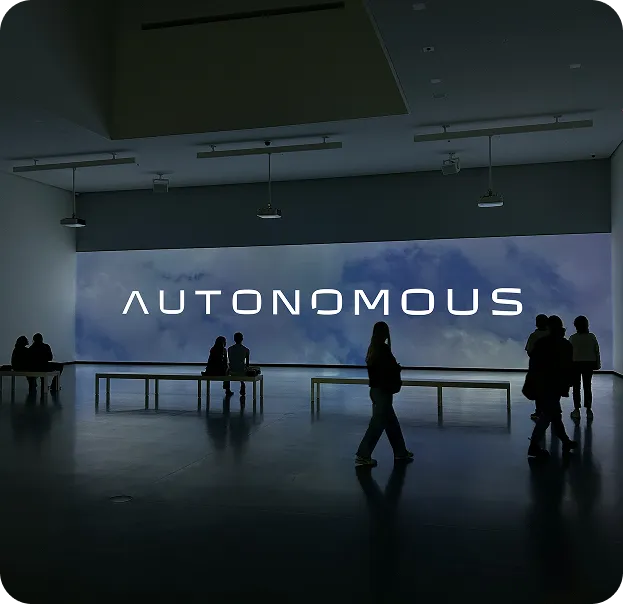
On Thursday, July 16, AIN’s correspondent spent a long day at The Midway in San Francisco for the inaugural edition of AUTONOMOUS, a new single-day conference for the robotics and physical AI industry. The event, produced by Frontier Media - the company founded by Rohan Savla after he left OpenAI earlier this year - deliberately kept attendance selective: roughly 500–600 founders, engineers, investors, and enterprise operators, with about 60 speakers across two stages and four content tracks. No booth-babble expo hall, no badge-scanning armies; the format was panels, firesides, live demos, and a startup showcase, capped by an official afterparty hosted by Moonlake AI.
What struck us most was what the room did not argue about. Nobody on stage debated whether the robots work - the arguments were about data, unit economics, and how long deployment takes. Savla’s curation filter, as he described it, was to put people on stage who are deploying robots with paying customers today, and the programming mostly held to it.
One brain, any body
Savla opened the day with a keynote titled “One Brain, Any Body,” arguing that the unlock for physical AI is a single foundation model that can drive any robot body rather than one model per machine. Skild AI CEO Deepak Pathak followed with the counter-thesis his billion-dollar startup is built on: robots that learn to act by predicting what happens next in the world, frame by frame, rather than being instructed in language. And MIT professor and Toyota Research Institute SVP Russ Tedrake closed the day with a sober assessment of moving general-purpose robots out of the lab and into production manufacturing.
Who took the stage
The four tracks - The Physical AI Frontier, The Humanoid Moment, Building & Deploying Robots, and Where the Money Goes - pulled in an unusually senior crowd for a first-year event. Among the roughly 60 speakers we saw across the two stages:
- Deepak Pathak (Skild AI) - CEO, on robots that learn by watching the world
- Russ Tedrake (MIT / Toyota Research Institute) - professor and SVP, closing keynote on deploying general-purpose robots
- Jamie Shotton (Wayve) - chief scientist, on world models as the bridge from self-driving to every robot
- James Kuffner (Symbotic) - the pioneer who coined “cloud robotics” fifteen years ago, on orchestrating thousands of warehouse robots
- Andrew Wooten (Rhoda AI) - co-founder and CPO, on building driverless freight inside a global truckmaker, in a fireside with Torc Robotics’ Peter Vaughan Schmidt
- Samir Menon (Dexterity) - CEO, on physical AI in the supply chain
- Ed Mehr (Machina Labs) - co-founder, on turning the factory itself into something you can reprogram
- Juraj Kabzan (Skydio) - VP of Autonomy, on drones, sidewalks, and the last mile
- Kevin Peterson (Bedrock Robotics) - on self-driving excavators and what it takes to run a robot fleet
- Fan-Yun Sun (Moonlake AI) - on generating endless simulated training worlds from a prompt (co-founder Sharon Lee was on the program but out sick)
- Sankaet Pathak - sparring in “The Humanoid Moment: Real or Overhyped?” moderated by The Information’s Rocket Drew
- Shayegan Omidshafiei - closing “Autonomy in the Wild” session on robots dropped onto sites they have never seen
- Tessa Lau (Dusty Robotics), Paul Mikesell (Carbon Robotics), Noah Ready-Campbell (Built Robotics), and Samuel Reeves (FORT Robotics) - the deployment-at-scale panel, moderated by Core Matter Labs’ Michelle Sun
- Chris Chen (Faraday Future), Adarsh Kulkarni (Foundry Robotics), and Lukas Pankau (Industrial Next) - the manufacturing panel, moderated by Saturday Robotics’ Junfan Zhu
- Kanu Gulati (Khosla Ventures), James Hardiman (DCVC), and Bilal Zuberi (Red Glass Ventures) - the investor panel, moderated by Drumbeat Capital’s Steve Jacobs
- Tim Bucher and Brett McMickell - on building the fully autonomous tractor, part of a farm-autonomy thread that also featured Ricky Stephens, Leonardo Carvalho, John Macdonald, and Vibhor Sood
- Xiaodi Hou, Kishore Veerashekar, Christian Stano, Shubham Shrivastava, and Andrew Culhane - the race-to-driverless-freight panel
- John Ha - on the hard-won economics of robots-as-a-service at fleet scale
Zuberi’s presence carried its own headline: he launched the $150 million physical-AI fund Red Glass Ventures this year after twelve years as a GP at Lux Capital, and the investor panel’s real question - is physical AI the next great frontier or the next bubble? - hung over the whole day. Bay Area companies were well represented throughout, with Skild AI, Skydio, Serve Robotics, and Wayve all on the program.
Three showcase pitches we won’t forget
The startup showcase produced the day’s most human moments. PSYONIC founder Aadeel Akhtar demoed his bionic hand and told the story of a customer who lost his hand in a fireworks accident and went on to throw a first pitch at a San Francisco Giants game. Kevin Damoa of Glīd - the road-to-rail freight startup that won TechCrunch Disrupt’s Startup Battlefield last fall - cited a nine-figure revenue pipeline and made his case with a stat: 72% of US freight travels by road while 140,000 miles of rail sit underused. And Amos Miller, who is blind, pitched Glidance while holding the product: Glide, a self-steering mobility guide with over a million dollars in pre-orders and 3,000 testers, including Andrea Bocelli and Stevie Wonder. Andromeda CEO Grace Brown rounded out a showcase field attacking deployment from four different directions.
For a first edition, AUTONOMOUS punched far above its weight, and it slotted neatly into a pattern we have watched all year - from Daytona’s Compute in March to this - of small, sharply curated San Francisco conferences outperforming the megashows on substance per hour. Frontier Media has already confirmed that AUTONOMOUS returns to San Francisco in 2027.